
In a lot of how-to-draw pages, a great deal happens between one step and the next. A box becomes a car with wheels, windows and a bumper, all at once. A child looks from the book to their own page and can’t tell what changed.
The trouble with big steps
A child of seven can copy a line. What’s hard is spotting which three lines are new in a picture full of lines, then working out which to draw first. When they can’t, they guess. The drawing drifts away from the one in the book, and they decide they can’t draw.
Most of the time the step was too big, not the child.
One new line, in a different colour
So in How to Draw Vehicles, every step adds one line. Just one. On the page, the new line is drawn in teal and everything before it stays grey, so a child can see exactly what to add next.
That makes the book patient. A drawing with many small steps isn’t harder than one with a few big ones. It’s easier, because no single step asks for much, and a child who gets one line right can usually get the next one right too.
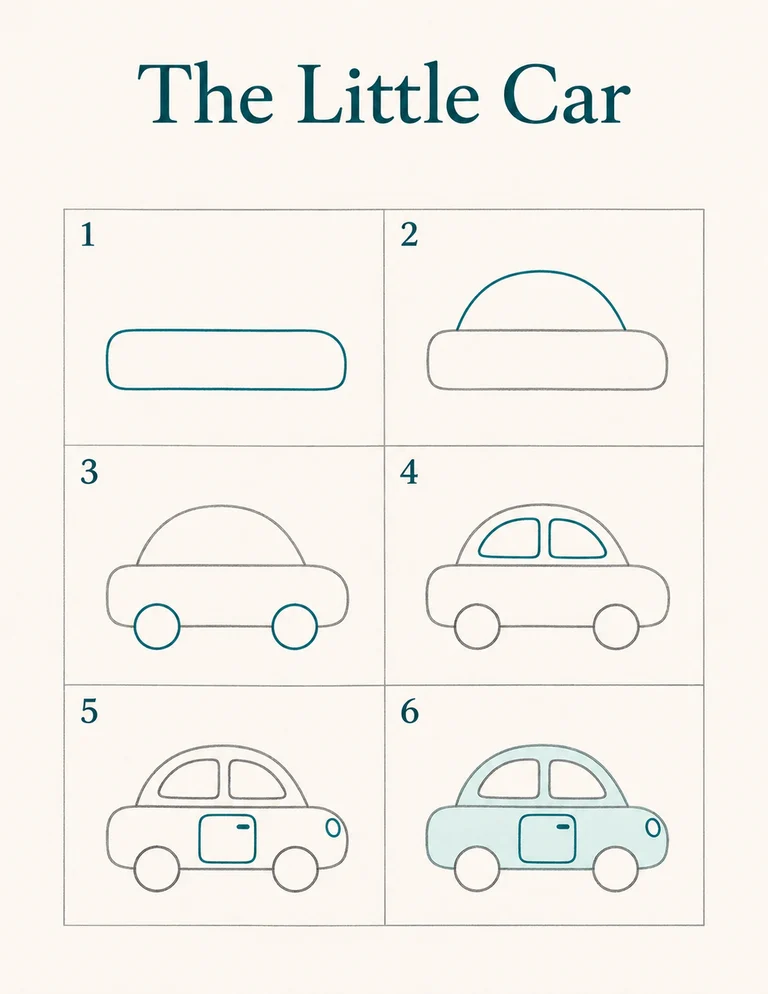
Each of the 60 vehicles gets two pages. The drawing grows across numbered panels, read left to right and top to bottom. Colour comes last, once every line is down. If the lines are right, the colouring is the easy part, and the best one.
Drawn by hand, tried by children
We draw every lesson by hand first. Then children try it before it goes to print. If a step trips them up, we treat that as a fault in the step and not in the child.
The book is written for ages 7 to 10, and for children who like things that go: cars, trains, boats and flying machines. At the end there are six bigger scenes that put them all on the same page.
It isn’t a technical drawing course for grown-ups. It does work well with a grown-up drawing alongside, one line at a time, the same as everyone else.
There is a free sample with five lessons to print at home. Our request form is still a preview, so it can’t send it yet.